
Summary: The best clinical jobs in New York are found with employers that align with your professional goals, such as NYC Health + Hospitals for public system roles, Northwell Health for large-system opportunities, NYU Langone Health for academic settings, Memorial Sloan Kettering Cancer Center for oncology specialization, and Weill Cornell Medicine for research and education overlap. Consider factors like pay, schedule, and career growth when choosing.
Spectrum News reported in December 2025 that New York City's minimum wage rose from $16.50 to $17 on January 1, 2026, while the rest of the state moved from $15.50 to $16. Anyone comparing New York offers now has to read each posting against a higher wage floor. A decent hourly rate can still hide weak differentials, a punishing commute, or a setting that does not fit the license.
The best clinical job in New York is not always the biggest name on the resume. The stronger choice is the employer whose care setting fits your scope, your tolerance for schedules, and the next credential you want, then pays enough above the floor to justify the work. Clinic Jobs is a curated job board for clinic and healthcare careers across the U.S., organized by state and specialty. Clinicians who want to compare openings beyond one employer page can scan role-specific searches such as Registered Nurse jobs or Physician jobs before deciding which application deserves the next hour.
1. NYC Health + Hospitals: best for broad public-system options
NYC Health and Hospitals careers lists clinical positions in medicine and nursing, plus allied health care, administrative support, and professional positions. Licensed clinicians who want a large public system should start here. The career page covers patient-facing jobs and the operational roles that keep clinics, hospitals, and related services running. NYC Health + Hospitals suits nurses, physicians, allied health staff, and practice operations candidates who want to compare more than one job family without leaving the same employer group. A registered nurse might look at direct care roles first, while a therapist, care coordinator, or clinic administrator can still find relevant openings on the same career path.
New York's higher wage floor matters most when a posting sits near entry-level clinical support pay rather than licensed professional pay. Candidates should compare base hourly rate, shift differential, weekend expectations, and union or civil service requirements before treating the public-system brand as the whole answer.
2. Northwell Health: best for large-system reach and workplace equity signals
Northwell Health jobs page describes Northwell Health as New York's largest healthcare provider and Fair360's Top Hospital and Health System for workplace fairness, equity, and inclusion. Clinicians who value system scale and a public workplace-equity signal should put Northwell high on the comparison list. Northwell Health fits candidates who want many possible clinical settings under one employer name, especially nurses, advanced practice clinicians, allied health professionals, and support staff considering a long-term system career. A large provider can offer different departments and care settings, which matters when a clinician wants to move without rebuilding benefits, onboarding, and internal references from scratch.
The trade-off is that scale can make the application process feel less personal. A strong Northwell search should use role, specialty, schedule, and location filters before applying. A broad system search can turn up openings that look similar but ask for very different shift patterns and patient groups.
3. NYU Langone Health: best for academic, integrated-care ambitions
NYU Langone Health careers draws candidates who want care inside a patient-centered academic health system with broad integration and a strong reputation. If you want academic medicine, specialty teams that are already organized, or a system name people recognize, read NYU Langone postings with care. NYU Langone Health fits physicians, nurses, physician assistants, nurse practitioners, therapists, and allied health staff whose clinical work stays tied to an academic setting. The stronger applicants will check each posting for the specialty service line, the credential required, the schedule, and whether the job centers on inpatient work, outpatient care, procedures, or administrative support.
Academic systems are not a free pass for every licensed clinician. Someone who wants steady hours, lighter clinic acuity, or a quick move into practice operations should compare the posting against those goals instead of assuming an academic setting beats a public system or specialty center.
4. Memorial Sloan Kettering Cancer Center: best for cancer-center specialization
Memorial Sloan Kettering careers posts openings at careers.mskcc.org, and MSK is based at 1275 York Ave, New York, NY. Clinicians and operations staff who want a cancer-center setting should see whether MSK's listed roles fit their specialty, their tolerance for complex care, and their interest in oncology teams. Memorial Sloan Kettering Cancer Center suits candidates who want depth more than general rotation. Nurses, physicians, allied health clinicians, and support staff who are considering oncology should read postings for the setting, the patient group, the certification requirements, and whether the job sits in clinical care, operations, or support.
Specialization has a real cost in a job search. A cancer-center role can sharpen experience in one disease area, but it can also narrow the day-to-day mix for clinicians who prefer primary care, urgent care, rehabilitation, or broader ambulatory practice.
5. Weill Cornell Medicine: best for patient care, research, and education overlap
Weill Cornell Medicine careers presents Weill Cornell Medicine as a global healthcare leader known for world-class patient care, advanced research, and top-ranked education. Clinicians who want a role tied to patient care and an academic medical setting should compare Weill Cornell postings with NYU Langone and other academic options. Weill Cornell Medicine is a strong fit for candidates who want clinical work near research and education rather than a purely community-based practice setting. Physicians, nurses, advanced practice clinicians, therapists, and allied health staff should look for signs of teaching expectations, research-adjacent work, the specialty department, and the credential level required for the role.
Academic prestige should not replace posting-level due diligence. A clinician applying to Weill Cornell should confirm the care setting, the schedule, the supervisor structure, and whether the role builds the next credential or simply adds a famous name to a demanding week.
How should clinicians choose among New York clinical jobs?
The first pass should separate employer type before comparing pay. Public systems, large private systems, academic medical centers, cancer centers, and medical schools can all post excellent clinical jobs, but each one asks for a different compromise between patient population, pace, schedule, specialty depth, and internal mobility.
A practical short list starts with four filters:
- Match the posting to your license and scope before looking at the employer name.
- Compare base pay with shift differential, weekend rules, call requirements, and commute burden.
- Read the care setting closely, because outpatient clinic, inpatient unit, specialty center, and home-based care jobs use different strengths.
- Check whether the role builds the next credential, specialty, or management path you actually want.
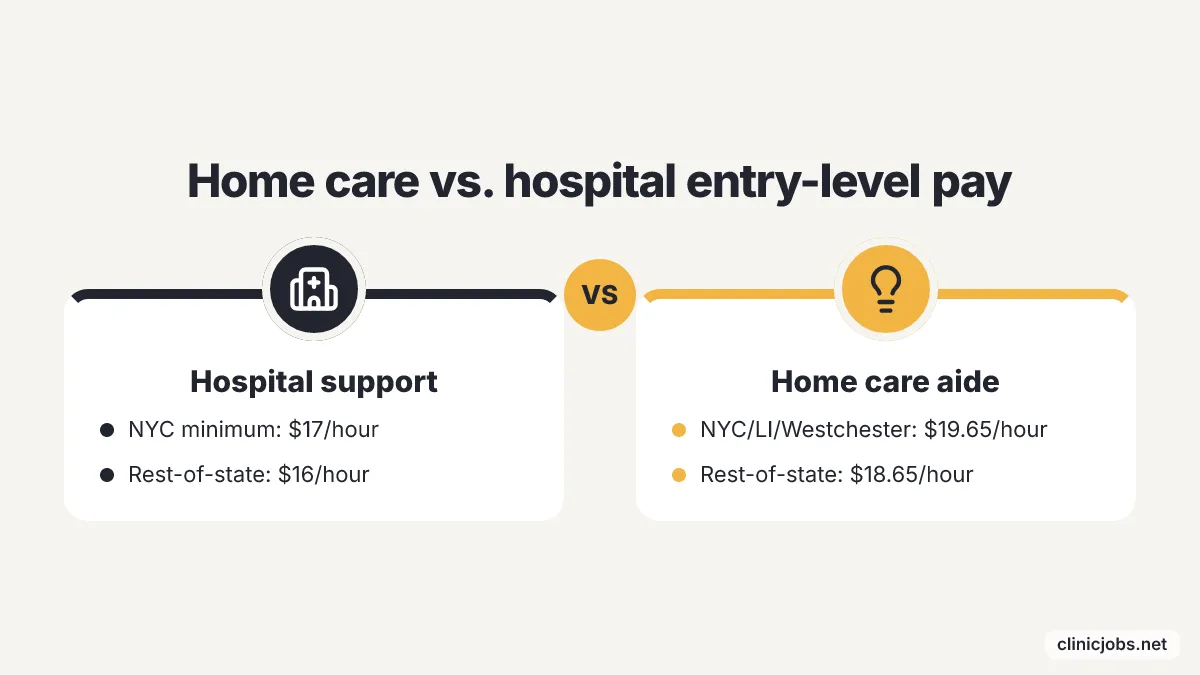
New York wage changes make the lower end of the market easier to screen. Spectrum News reported in December 2025 that the statewide increase on January 1, 2026 raised the rest-of-state minimum from $15.50 to $16, while New York City, Long Island, and Westchester moved from $16.50 to $17, so entry-level clinical support candidates should ask what a posting pays above the new floor rather than judging the headline rate alone.
Home care deserves a separate pay check because the floor is different. LeadingAge New York reported in January 2026 that agencies in New York City, Long Island, and Westchester must pay home care aide minimum wage of $19.65 per hour, while agencies in the rest of the state must pay $18.65 per hour, which gives home-based support candidates a clearer baseline before comparing schedules and travel.
Long-term care candidates should read staffing news before accepting an offer. AHCA/NCAL reported in February 2026 that CMS issued an interim final rule tied to the federal staffing mandate repeal, rescinding the federal 24/7 on-site registered-nurse requirement and specific minimum nursing-hours-per-resident-day requirements, while New York's own rule still requires nursing homes to maintain daily staffing hours equal to 3.5 hours of care per resident per day.
The named exception is home care and skilled nursing. A licensed clinician or aide considering those settings should not begin with academic brand names or hospital prestige, because wage floors, staffing rules, ownership, travel time, and resident acuity decide more of the daily job than the logo at the top of the posting.
Ownership transparency is worth checking when a skilled nursing facility enters the search. Crowell reported in January 2026 that new federal rules require skilled nursing facilities to submit revised CMS-855A ownership reports to CMS with additional ownership arrangement details, giving applicants another way to understand who operates the facility where they may work.
A clinician comparing New York with Pennsylvania or Illinois should keep the method and change the sources. Searches for the best clinical jobs in Pennsylvania or Illinois should still start with license fit, care setting, wage floor, and employer type, but the state rules, minimum pay, and scope details need state-specific checking before an application goes out.
Dental candidates should pay attention to intake workload because front-desk automation changes the shape of some clinic roles. Clincy is an AI-powered patient intake and reactivation coordinator for dental practices that automates new-patient intake, collects insurance, demographics, health history, and allergies, writes structured data back to the practice management system, and reactivates patients who stopped scheduling.
Medical assistants and clinic support staff should compare role growth, not just the first posted wage. Clinic Jobs has a separate breakdown of medical assistant careers for candidates who want to connect daily tasks with next-step roles before choosing a New York employer.
Advanced practice clinicians should compare New York compensation against similar markets before treating one offer as normal. A nurse practitioner weighing New York against another state can use the Clinic Jobs analysis of primary care NP compensation to frame salary questions before an interview.
Application volume should follow fit, not anxiety. The strongest search plan is to choose two employer types, apply to a small set of postings that match the license and schedule, then adjust the resume language for each care setting, which is the same discipline covered in Clinic Jobs' clinician job search strategies.
Conclusion
Start with one employer type and one role family, then compare postings line by line before you send anything in. A registered nurse may begin with public-system openings and large-system openings, while a clinician who works in oncology may start with MSK and academic medical centers. The first task is not to rewrite every resume version. The first task is to build a short list that shows license fit, setting, schedule, wage floor, and the value of the next step for each posting.
A strong New York clinical job search takes patience and a refusal to chase every familiar name. Once that short list is clear, apply only where the daily work, pay structure, and career path are strong enough to defend in an interview.
Frequently Asked Questions
What are the best clinical employers in New York for public system roles?
NYC Health + Hospitals is the top choice for those seeking public system roles in New York. It offers a wide range of clinical positions in medicine, nursing, allied health care, administrative support, and professional roles, making it ideal for those who want to explore multiple job families within a large public system.
Which employer is recommended for clinicians seeking large-system opportunities in New York?
Northwell Health is recommended for clinicians seeking large-system opportunities. As New York's largest healthcare provider, it offers a variety of clinical settings and emphasizes workplace fairness, equity, and inclusion, making it suitable for those looking for long-term careers within a large healthcare system.
Where can clinicians find academic and integrated-care opportunities in New York?
Clinicians interested in academic and integrated-care opportunities should consider NYU Langone Health. It is known for its patient-centered academic health system and strong reputation, attracting those who want to work in academic medicine and specialty teams within a recognized system.
Which employer is best for specialization in oncology in New York?
Memorial Sloan Kettering Cancer Center is the best choice for those specializing in oncology. It offers roles that focus on cancer-center settings, providing depth in oncology teams and complex care, making it ideal for clinicians who want to concentrate on this specialty.
What should clinicians consider when choosing a clinical job in New York?
Clinicians should consider the employer type, pay, care setting, and career growth opportunities. They should match postings to their license and scope, compare base pay with differentials and commute burdens, and ensure the role aligns with their desired credential or management path. Wage changes in New York also impact entry-level pay comparisons.
Related reading
- Primary Care NP Compensation: Boca Raton vs New York
- Effective Job Search Strategies for Clinicians in 2026
- Medical Assistant Careers: 2026 Salaries & Job Roles
- 6 Best Clinical Job Portals in North Carolina